Environmental issues.
Responsible design · Designing and making principles
Revision notes
Environmental Issues
Sustainable development means meeting the needs of the current generation without compromising the ability of future generations to meet their own needs. Responsible designers consider environmental, social and economic effects throughout a product's life.
Sustainable materials and components
Designers should aim to minimise environmental impact while still meeting the product's functional requirements. Important considerations include:
- conserving materials, for example by nesting components to reduce waste
- reducing energy use during manufacture
- selecting materials and components that make the product as sustainable and environmentally responsible as possible
- considering the product's carbon footprint
- considering product miles, the lifetime distance travelled from production to use.
Carbon footprint
A carbon footprint is the total amount of carbon dioxide released as a result of the activities associated with a person, organisation or product.
A primary carbon footprint concerns direct emissions, such as CO₂ produced by burning fossil fuels for transport or energy use. A secondary carbon footprint concerns indirect emissions associated with products and their supply chains.
Designers therefore need to consider more than factory emissions. Material extraction and processing, transport, use and end-of-life treatment can all affect the overall impact.
Economic, social and environmental factors
Sustainable development involves more than environmental impact alone.
- Economic: material cost, use of finite resources, sourcing, energy and processing costs, pollution-control costs and the cost of providing appropriate working conditions.
- Social: the effect of processing pollution on people's health and the working conditions of people involved in manufacture.
- Environmental: use of finite resources, energy source, pollution, recycling and what happens to materials at the end of the product's life.
Environmental impact of packaging
Packaging must protect and preserve the product while avoiding unnecessary material. Designers and manufacturers can reduce impact by:
- making packaging lightweight
- using recycled content
- making packaging recyclable or reusable
- using refills and concentrates
- using the minimum practical amount of packaging material.
Reducing packaging is only successful if the product remains adequately protected. Packaging that is too minimal can lead to damaged products and additional waste.
Circular economy: biological and technical nutrients
A linear economy follows take → make → use → dispose (cradle-to-grave). A circular economy aims to design out waste and pollution, keep products and materials in use at their highest practical value, and regenerate natural systems. This is closely linked to cradle-to-cradle design, where materials are treated as resources for another cycle rather than waste.
The butterfly diagram shows two material cycles. Biological nutrients can safely return to the biosphere; technical nutrients should remain in managed industrial cycles. The word nutrient here means a material that can feed a future cycle, not necessarily a food nutrient.
| Biological cycle | Technical cycle |
|---|---|
| Materials: suitable biodegradable, non-toxic biological materials such as food waste, untreated natural fibres and some untreated wood. | Materials: metals, glass, synthetic polymers and durable manufactured components that should not be released into nature. |
| Route: use → collection → composting or anaerobic digestion → nutrients returned safely to soil and ecosystems. | Route: use → maintenance/repair → reuse/redistribution → refurbishment/remanufacture → material recycling when higher-value options are no longer practical. |
| Goal: regenerate natural systems and return useful nutrients, while making the most of the material before it biodegrades. | Goal: retain the product's function, components and material value for as long as possible, reducing demand for virgin resources. |
Biological example: uncontaminated food scraps can be composted; microorganisms break them down and the resulting compost can improve soil. In anaerobic digestion, microorganisms break down suitable organic waste without oxygen, producing biogas and digestate that may be used as a soil amendment if safe.
Technical example: an aluminium bicycle frame can be maintained and repaired, passed to another user, or recycled into new metal products when it can no longer be used. Recycling generally requires more processing than continued use or repair, so it is not automatically the first choice.
Cascading means using a biological material for several applications before its final safe return to nature: for example, untreated natural fibres might be reused as stuffing or insulation before appropriate biological treatment.
Design implications: choose safe materials and finishes; make parts easy to separate; avoid permanently bonding incompatible materials; enable repair and replacement; and plan collection or take-back systems. A product made from natural material is not automatically a biological nutrient: toxic dyes, coatings, adhesives or mixed synthetic fibres can prevent safe return to soil. Likewise, a polymer labelled biodegradable may need specific industrial composting conditions.
Evaluation: circular systems still use energy and transport, and collection, sorting and material contamination can limit recovery. Designers must consider the whole life cycle rather than assuming that compostable or recyclable always means environmentally preferable.
View the Ellen MacArthur Foundation's butterfly diagram to see both cycles and the order of technical recovery loops.
Evaluating environmental decisions
No single feature makes a product sustainable. A lighter product may use less energy in transport or use, but its material may require more energy to process or be difficult to recycle. A durable, repairable product may use more material initially but remain useful for much longer.
Environmental decisions should therefore be considered across the product's life cycle and alongside economic and social consequences.
The Six Rs and FSC timber
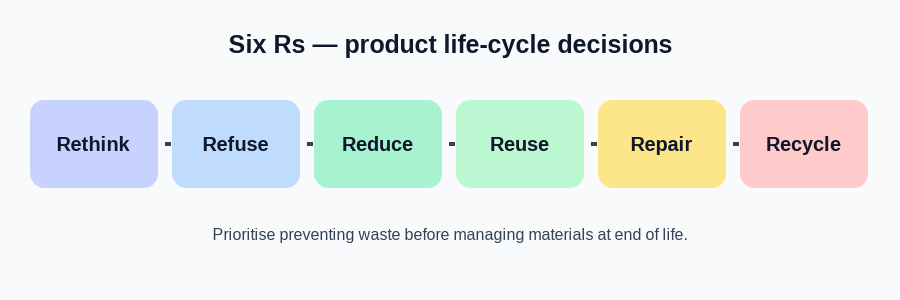
Applying the Six Rs
Common classroom versions of the Six Rs use slightly different word sets; a useful framework is Rethink, Refuse, Reduce, Reuse, Repair, Recycle. In every case connect the action to a product and the resulting environmental benefit.
- Rethink: reconsider whether a disposable product is needed; design a refill service instead.
- Refuse: reject unnecessary single-use packaging.
- Reduce: use less material through efficient nesting without compromising performance.
- Reuse: design a delivery crate to be collected and used repeatedly.
- Repair: use removable screws and replaceable components rather than permanently bonding everything.
- Recycle: mark material types and allow easy separation of aluminium and polymers at end of life.
Some resources use Recover or Repurpose as one of the Rs; follow your course's stated version while understanding the underlying strategies.
FSC: Forest Stewardship Council
The FSC runs forest-management and chain-of-custody certification schemes intended to support responsible forestry and traceability of eligible forest-based materials. Look for the FSC mark and relevant claim when selecting timber, board or paper.
FSC 100% uses material from FSC-certified forests; FSC Recycled uses recycled forest-based material; FSC Mix combines eligible certified, recycled and/or controlled sources according to FSC rules. A logo is not a blanket claim that a product has zero environmental impact.
Responsible timber selection should also consider species, durability, transport, adhesives, finishes, waste, and how long the product is used.
Further reading: FSC labels.


Think you have got this topic?
Test yourself before moving on, or use flashcards for a quick recall session.